
Key takeaways
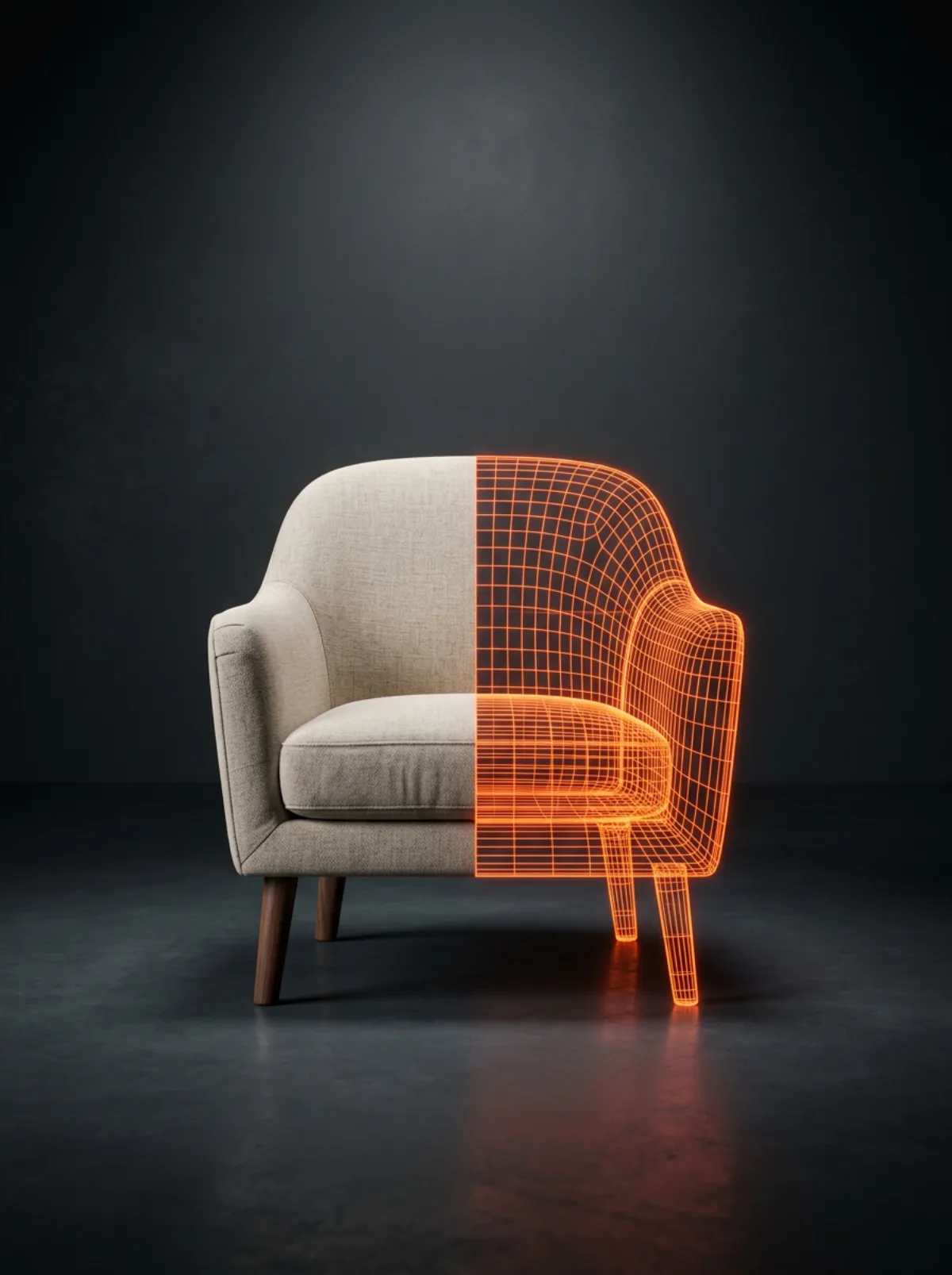
3D product rendering creates photorealistic images of a product from a digital model, without a physical photoshoot.
One accurate model can produce endless angles, colours, materials and room scenes.
It is ideal for furniture, appliances, doors, building materials and any product that is expensive to ship or photograph.
The same model can also power animations, configurators, ads and product pages.
3D product rendering is the process of turning a digital 3D model into realistic product images or videos.
Instead of building sets and shipping samples to a studio, a 3D artist recreates the product, its materials and its lighting in software. The result looks like a photograph, but it is faster to update and far easier to reuse.
What Is 3D Product Rendering?
At its core, 3D product rendering combines three ingredients. First, there is a precise 3D model of the product. Second, there are realistic materials, such as fabric, wood, metal or glass. Third, there is lighting and a camera, which turn the scene into a final image.
When these parts are done well, viewers cannot tell the difference between a render and a studio photo. In fact, many of the furniture and appliance images you see in catalogues today are renders.
The approach is not limited to still images either. Once the model exists, the same file can produce 360-degree views, short product animations and lifestyle scenes in different rooms.
Why Brands Choose 3D Product Rendering Over Photography
Traditional product photography still has its place. However, it becomes slow and costly when you have many products, many variants or products that do not exist yet. That is where 3D product rendering shines.
No physical samples needed. You can show a product before the first unit leaves the factory.
Unlimited variations. Changing a colour, fabric or finish takes minutes rather than a new shoot.
Consistent quality. Every image follows the same lighting, angle and style across the whole catalogue.
Perfect scenes. Instead of renting locations, you can build the ideal living room, office or showroom digitally.
Reusable assets. The model can be used again for ads, social media, packaging and future campaigns.
As a result, many manufacturers now use renders for most catalogue and website images. Meanwhile, they keep photography for people, events and behind-the-scenes content.
How the 3D Product Rendering Process Works
Every studio works slightly differently, yet the main steps are similar. Here is the workflow our team follows.
1. Brief and references
We collect technical drawings, CAD files, dimensions, material samples and photos. In addition, we agree on the purpose of the images, such as a catalogue, a website or a trade fair stand.
2. 3D modelling
Next, our artists build the product in 3D with accurate proportions. For furniture, this includes seams, cushions and small hardware. With appliances or doors, it covers panels, handles and logos.
3. Materials and textures
Then we recreate each surface. Wood grain, brushed steel, leather and fabric all need their own texture, reflection and roughness settings.
4. Lighting and scene setup
Afterwards, we place the product on a clean studio background or inside a lifestyle scene. Lighting decides the mood, so we test several setups before choosing one.
5. Rendering and post-production
Finally, the computer calculates the final images. Our team then adjusts colour, contrast and small details, and exports files for print, web and social media.
The first product takes the most time. After that, new colours, angles or rooms can be added much faster.
Where You Can Use 3D Product Rendering
The same 3D product rendering assets can support almost every channel.
Catalogues and price lists
Renders keep printed and digital catalogues consistent. When a product changes, you only update the model rather than reshooting the whole range.
Websites and e-commerce
High-quality images reduce questions and returns. Moreover, white-background renders work well for marketplaces, while lifestyle scenes help shoppers imagine the product at home.
Advertising and social media
Short animations, close-ups and seasonal scenes keep social feeds fresh without new shoots. Similarly, renders can be cropped for every ad format.
Trade fairs and showrooms
Large prints, screens and video walls can show products that are too big or too numerous to bring to a stand.
Architecture and retail spaces
The same skills also apply to shops, offices and exhibition stands. You can review a space in 3D before building it, which saves time and costly changes.
How Much Does 3D Product Rendering Cost?
Pricing depends on product complexity, the number of images and whether you need studio shots, lifestyle scenes or animation. A simple product on a white background costs much less than a detailed sofa in a fully furnished room.
In most cases, the first model is the biggest investment. Each extra angle, colour or scene then costs a fraction of the first. Consequently, 3D product rendering often becomes cheaper than photography for brands with large or frequently changing ranges.
To get an accurate quote, prepare your drawings, a product list and a few reference images you like.
3D Product Rendering Examples From Our Studio
At Arteneldigitale, our 3D team has worked with manufacturers and retailers in furniture, heating, doors and building materials. Here are some real examples.
İstikbal Türkyılmazlar: furniture in realistic rooms
For İstikbal Türkyılmazlar, we created product-focused CGI scenes that show furniture form, materials, proportions and spatial character. The renders present bedroom and living room sets in clean, believable interiors.
GRON: a technical product made clear
For GRON's condensing boiler, we built a detailed 3D model and used it for product visuals and motion content. As a result, a technical product became easy to understand at a glance.
Portal Door and Happy Bed: spaces and showrooms
For Portal Door, we visualised a trade fair stand and product space. Similarly, for Happy Bed we produced architectural visuals of the showroom building. In both cases, the client could review the space before building it.
You can explore these projects in our portfolio.
Why Work With Arteneldigitale for 3D Product Rendering
Arteneldigitale is a full-service digital agency headquartered in Italy, with offices in the USA and Türkiye. We have worked with more than 100 businesses in 15 countries, and 3D modelling is one of our 14 core services.
What makes our team useful for manufacturers is that 3D is not an isolated service for us. The same models can go straight into your website, your catalogue, your ads and your social media, because our designers, developers and marketers work in one team.
Our 3D product rendering services include:
Photorealistic product renders on white or styled backgrounds
Lifestyle and room scenes for furniture and home products
360-degree views and product animations
Exhibition stand, showroom and retail space visualisation
Catalogue, website and social media image sets
If you would like to see your products in 3D, visit arteneldigitale.com and send us a short brief. We usually reply within one business day with a clear plan.
Tips to Get Better 3D Product Rendering Results
Before you start a project, a little preparation goes a long way.
Share technical files. CAD or detailed drawings make the model more accurate.
Send real material samples. Photos of fabrics, finishes and colours help match reality.
Define the use. Print, web and video all need different sizes and settings.
Collect references. A few images you like will guide the style and mood.
Plan variants early. Listing all colours and sizes up front keeps the project efficient.
Final Thoughts on 3D Product Rendering
3D product rendering gives brands more control, more flexibility and more reusable content than traditional photography alone. It lets you show products before they exist, update catalogues quickly and present every item in its best light.
If your range is growing or changing often, it may be time to move your visuals into 3D.
Frequently asked questions
Is 3D product rendering cheaper than photography?
For a single item, photography can be cheaper. However, with many products, variants or room scenes, 3D product rendering usually costs less over time because the model is reused.
How realistic is 3D product rendering?
With accurate models, materials and lighting, renders can look identical to professional photographs.
What files do I need for 3D product rendering?
CAD files or technical drawings are ideal. Otherwise, dimensions, photos from several angles and material samples are enough to start.
How long does a 3D product rendering project take?
A single product with a few images can take a few days. Larger sets, room scenes and animations take longer, depending on revisions.